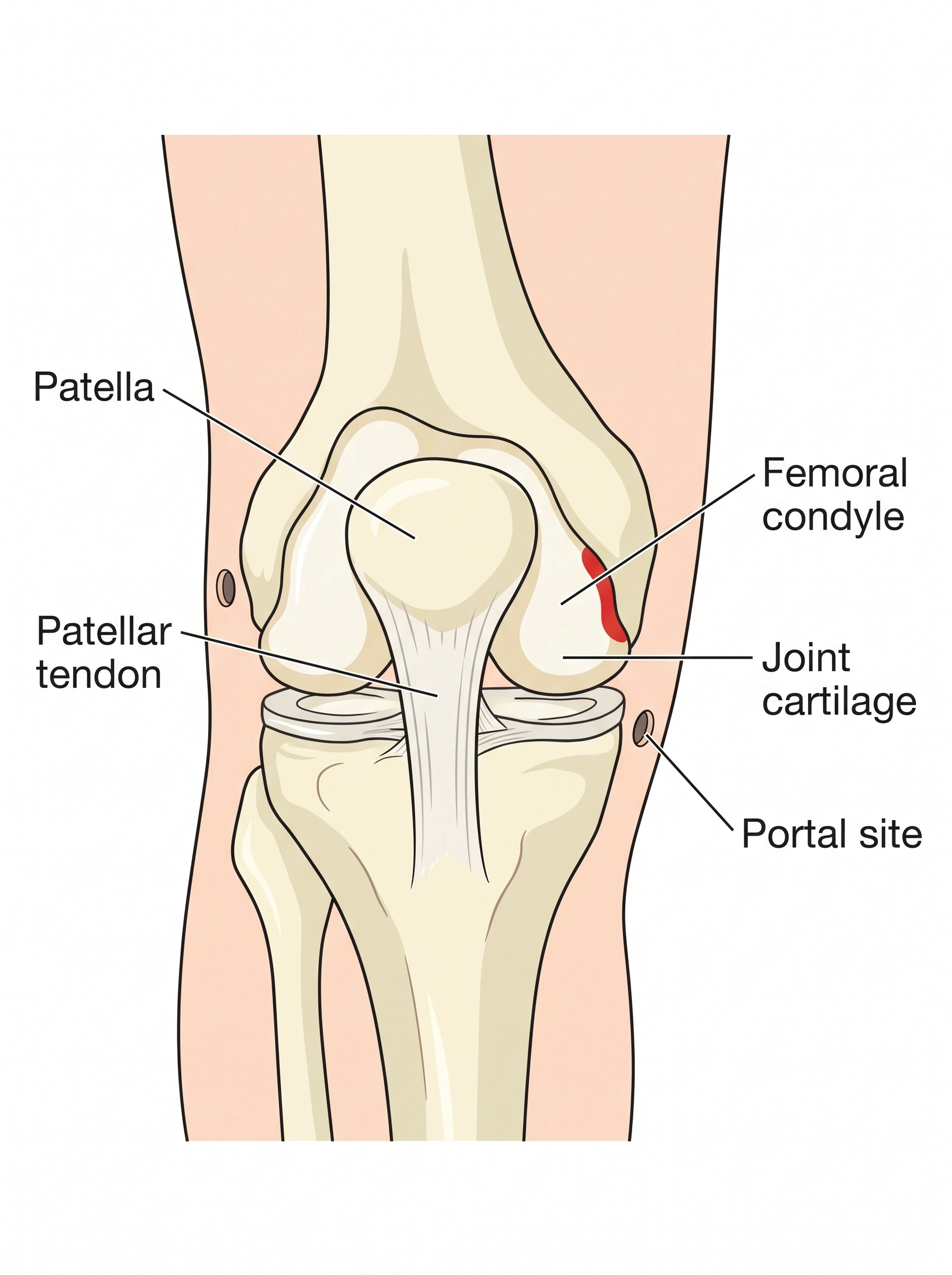
Knee arthroscopy is a minimally invasive surgery that uses a small camera and thin tools through tiny cuts to look inside the knee and treat problems. It is used for certain cartilage, meniscus, and loose-body issues. Many people go home the same day and recover over a few weeks.
Ross Wodicka performs knee arthroscopy in Fort Lauderdale when it is the right step, and reviews every alternative with you first.
What is Knee Arthroscopy?
Knee arthroscopy is a procedure that lets a surgeon see and work inside the knee through very small openings.
The word comes from arthro (joint) and scopy (to look). The surgeon inserts an arthroscope, a pencil-thin tube with a camera and light, and views the inside of the joint on a screen. Thin instruments go through other small cuts to trim, repair, or remove tissue.
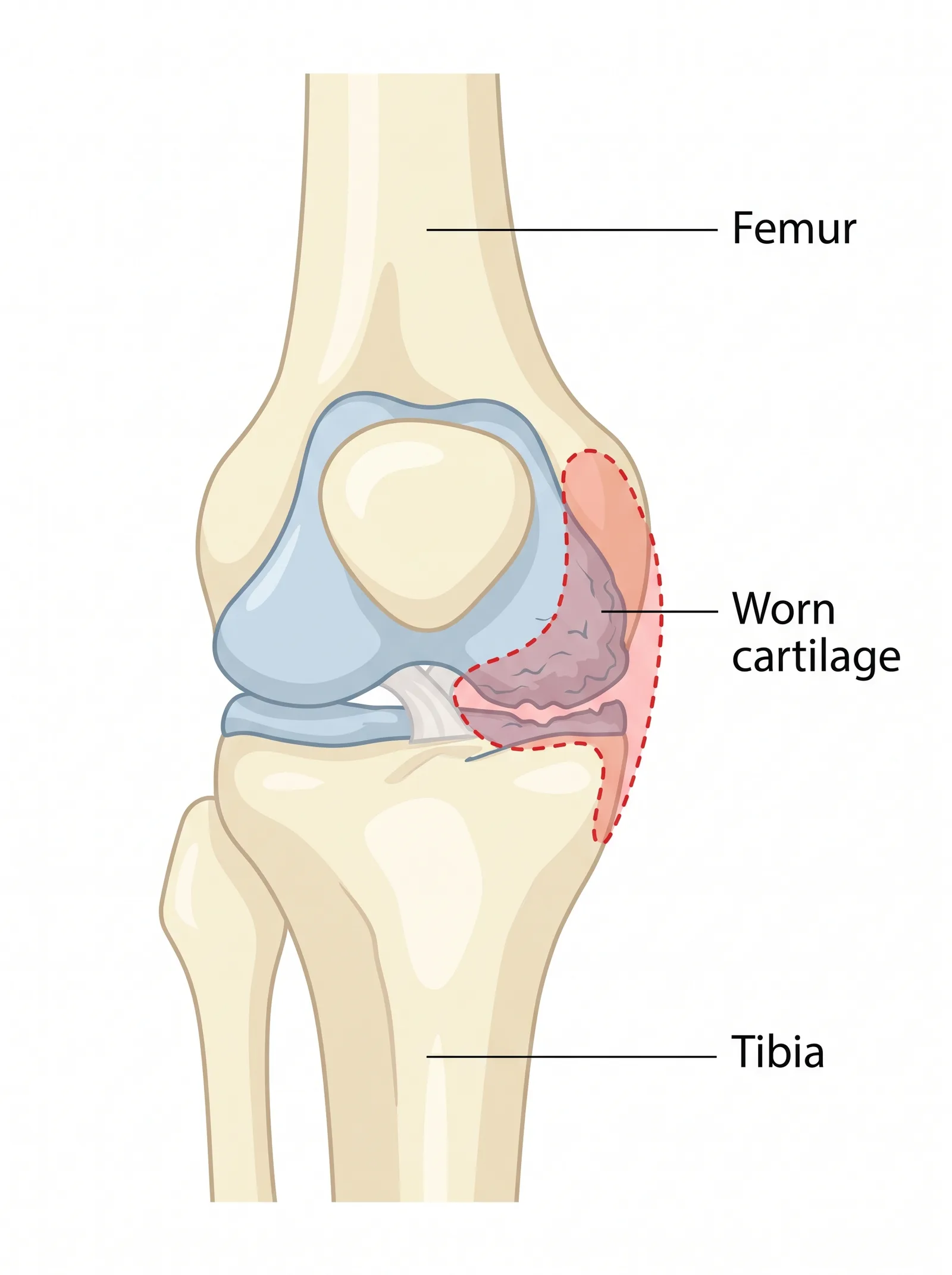
Because the openings are small, this is called minimally invasive surgery. It is used to address specific problems inside the knee, such as a torn meniscus (the cushion between the bones), damaged cartilage, or loose fragments floating in the joint. Arthroscopy is a tool, not a single fixed operation, so what happens inside depends on what the surgeon finds and the plan you agreed on.
This is a deep-education page. For a shorter overview, see our Knee Arthroscopy service page, which links back here.
What are the symptoms of Knee Arthroscopy, and when should you see a specialist?
People who may benefit from arthroscopy often have mechanical symptoms, meaning the knee behaves as if something is caught inside.
Common signs include the following.
- Catching, clicking, or locking, where the knee sticks and will not move freely. - A feeling that the knee gives way. - Swelling that returns after activity. - Pain in a specific spot, often along the joint line. - Symptoms that started with a twist, a squat, or a sports injury.
See a specialist when these symptoms limit what you do or do not settle with rest and therapy. An orthopedic surgeon can sort out whether the problem is one that arthroscopy can help, since not all knee pain is. Widespread arthritis, for example, usually does not improve with arthroscopy alone.
How is Knee Arthroscopy diagnosed, and what does the visit involve?
The visit begins with your history, especially any injury and any catching or locking.
The surgeon examines the knee, testing the meniscus and ligaments with specific hand movements and checking where it hurts.
X-rays check the bones and joint space. An MRI (a soft-tissue scan) is often ordered because it shows the meniscus and cartilage that X-rays cannot. The surgeon combines the exam and imaging to decide whether a problem inside the knee is likely to respond to arthroscopy, and to plan what may need to be done.
What happens during Knee Arthroscopy, step by step?
On surgery day, the usual sequence is the following.
- Anesthesia. An anesthesiologist gives you medicine so you feel nothing. This may be general anesthesia or a spinal or regional block that numbs the leg. - Small incisions. The surgeon makes two or more tiny cuts around the knee. - Inserting the camera. Sterile fluid gently fills the joint to open the space, and the arthroscope goes in so the surgeon can see clearly. - The work. Depending on the plan, the surgeon may trim a torn meniscus, smooth rough cartilage, or remove loose fragments. If a repair is needed instead of trimming, the surgeon may place stitches in the tissue. - Closing. The fluid is drained, the small cuts are closed with stitches or strips, and a dressing is applied.
Arthroscopy often takes under an hour, though your time depends on what is done.
What is the recovery timeline for Knee Arthroscopy?
Recovery depends heavily on what was done inside the knee.
A simple trimming heals faster than a repair. Milestones matter more than dates. The ranges below reflect general AAOS guidance, 2023. These are ranges, not promises.
First days. The milestone is walking with support and managing swelling with rest, ice, and elevation. Many people bear weight soon after, though a repair may require limits.
First weeks. The milestone is walking comfortably, regaining motion, and returning to a desk job. Many people reach this within a couple of weeks for simpler procedures.
Several weeks. The milestone is returning to normal daily activity and, for many people, light exercise. General AAOS guidance, 2023, notes recovery for straightforward arthroscopy often falls within several weeks, but this is a range, not a promise.
A few months. The milestone is returning to sport or heavier activity, especially after a repair, which needs more healing time. Your surgeon will clear you based on strength and stability, not the calendar alone.
Physical therapy guides the pace.
Read the full guide to preparing for surgery →
Your own recovery instructions come from the office and are specific to you. This page describes the general course, not a plan to follow.
How should you prepare for Knee Arthroscopy?
A little preparation makes the visit more useful.
- Home setup. Set up a spot to rest with your leg elevated, and keep ice packs ready. Clear walking paths. - Transportation. Arrange a ride home, since you cannot drive after anesthesia. - Time off. Plan for a few days to a couple of weeks away from work, depending on your job and the procedure. - Who to have available. Have someone with you the first day. - Pre-surgery health. Share your medicine list and follow any instructions about pausing certain medicines.
Which warning signs should you call about?
Call the office if you notice the following.
- Fever, or redness, warmth, or drainage from an incision, which can signal infection. - Calf pain or new leg swelling, which can signal a blood clot. - Sudden chest pain or trouble breathing. Call 911. - Swelling or pain that keeps worsening instead of easing. - A knee that locks or will not bear weight when it should.
When unsure, call the office. For emergencies, call 911.
What results can you expect from Knee Arthroscopy?
Outcomes depend on the reason for surgery.
According to general AAOS guidance, 2023, arthroscopy for mechanical problems such as a locking meniscus tear or a loose body often relieves those specific symptoms well. The same guidance, AAOS, 2023, notes that arthroscopy is generally not effective for pain caused mainly by widespread arthritis. These statements describe groups of people, not promises about any one person.
The office can explain what results are reasonable for your specific problem.
What do patients ask most?
Is arthroscopy the same as a knee replacement?+
Will I have a cast?+
How soon can I drive?+
How do I handle insurance and cost questions?+
Will it fix my arthritis?+
What are the treatment options?
- 01Rest and activity changesto calm the joint.
- 02Physical therapyto strengthen the muscles that support and steady the knee.
- 03Medicine, such as anti-inflammatory drugs (medicines that reduce swelling), used as directed.
- 04Injectionsto quiet inflammation in some cases.
- 05Bracingfor support during activity.
Fellowship trained at Southern California Orthopedic Institute, Los Angeles (Sports Medicine). Sees patients in Fort Lauderdale.
About Dr. Wodicka →