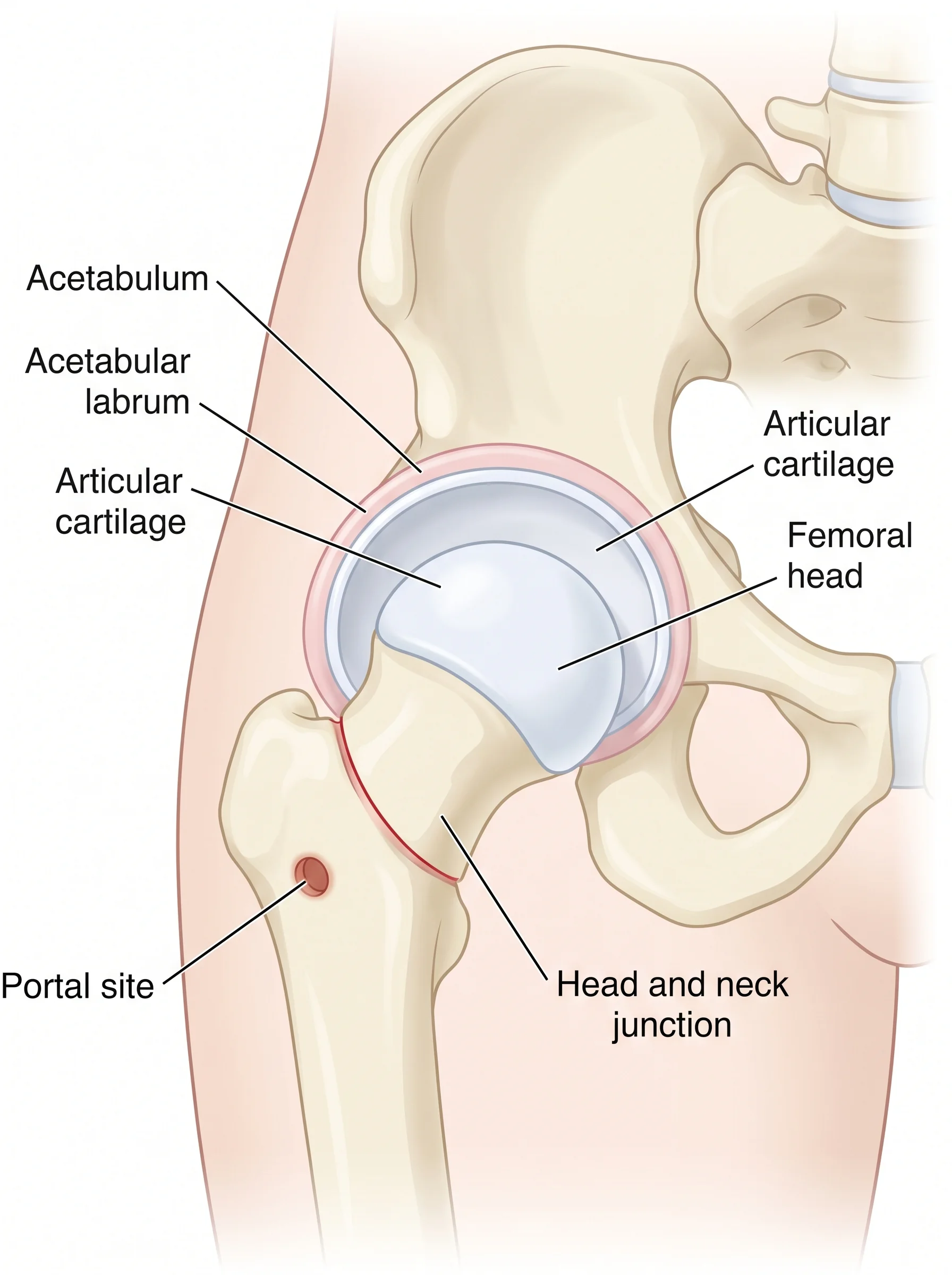
Hip arthroscopy is surgery that uses a small camera and thin instruments through tiny incisions to treat problems inside the hip, such as a labral tear or impingement. Dr. Wodicka performs hip arthroscopy in Fort Lauderdale for select patients when non-surgical care has not relieved symptoms.
Ross Wodicka performs hip arthroscopy in Fort Lauderdale when it is the right step, and reviews every alternative with you first.
What is Hip Arthroscopy?
Hip arthroscopy is a procedure that lets the surgeon see and work inside the hip through small openings.
A camera called an arthroscope is placed through a tiny incision, and thin instruments go through other small incisions. The surgeon watches the joint on a screen while working.
It is used to treat conditions such as a labral tear, which is a split in the cartilage ring around the socket, and femoroacetabular impingement, which is extra bone that makes the joint pinch. It can also remove loose fragments inside the joint.
Because the incisions are small, arthroscopy is a less invasive way to reach the joint than open surgery. It is used when the problem is suited to this approach and non-surgical care has not worked.
What happens during Hip Arthroscopy, step by step?
During hip arthroscopy, the leg is gently positioned so the surgeon can open a small space within the joint.
The arthroscope, a small camera, is inserted through a tiny incision, and thin instruments are placed through one or two more. Guided by the camera view, the surgeon can repair or trim the labrum, reshape extra bone in impingement, or remove loose pieces.
The specific work depends on what is found and on the plan made before surgery. Arthroscopy suits problems inside the joint that can be reached this way; it is not used for advanced arthritis, which is treated differently.
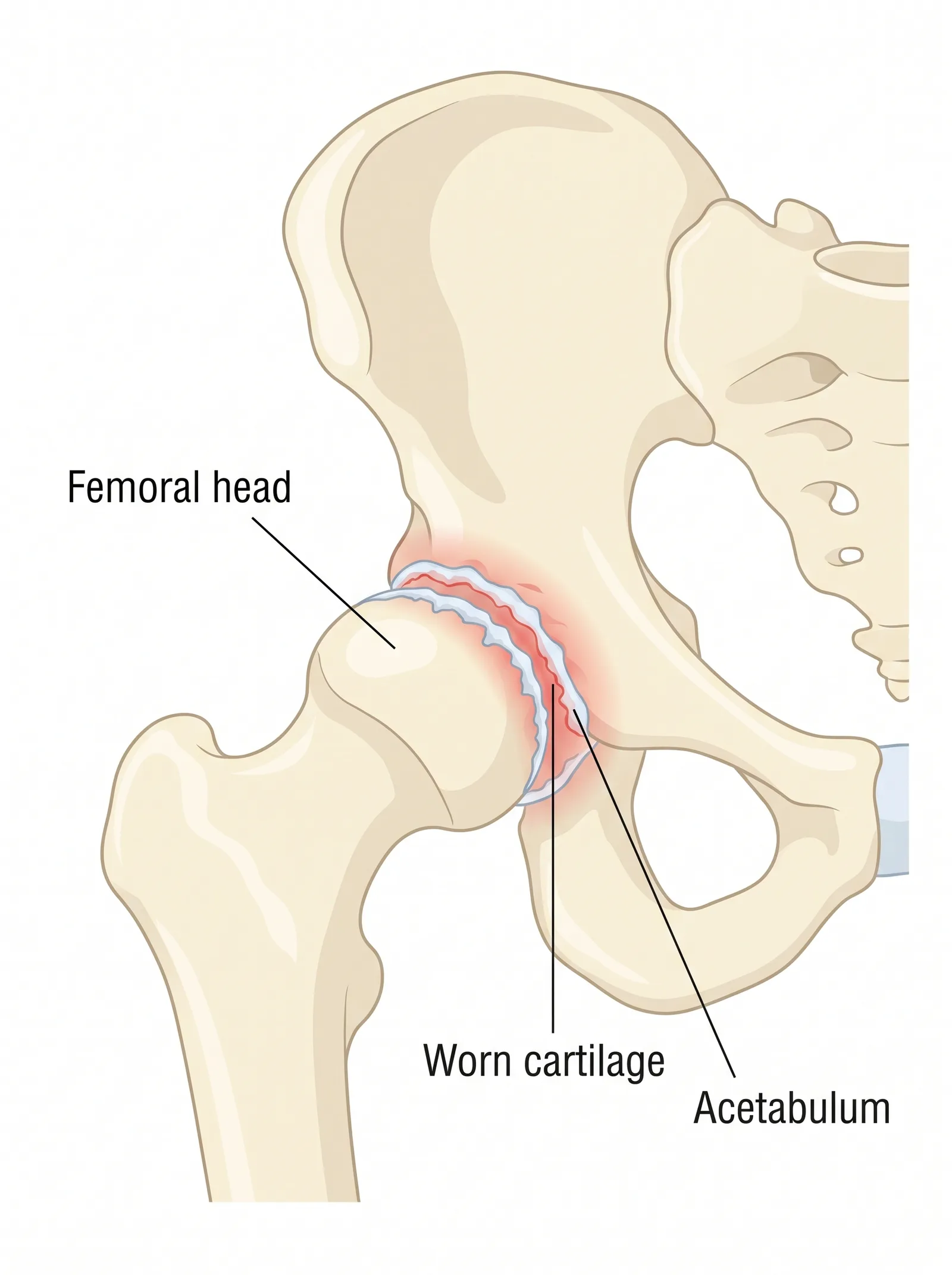
What is recovery like after Hip Arthroscopy?
Recovery from hip arthroscopy happens in stages.
Many people use crutches for a period to protect the hip, then move off them as directed. Physical therapy is a central part of recovery and often continues for a number of weeks. Returning to low-impact activity commonly takes about 6 to 12 weeks, with a longer timeline for demanding sports, according to general guidance from the American Academy of Orthopaedic Surgeons. These are ranges, not promises. Your timeline depends on what was done, your health, and your rehabilitation. Your surgical team will map it with you.
Read the full guide to preparing for surgery →
Your own recovery instructions come from the office and are specific to you. This page describes the general course, not a plan to follow.
What do patients ask most?
What conditions does hip arthroscopy treat?+
Is hip arthroscopy major surgery?+
How long does recovery from hip arthroscopy take?+
Will hip arthroscopy fix my hip pain?+
What are the treatment options?
- 01Activity changes to avoid the movements that trigger painActivity changes to avoid the movements that trigger pain.
- 02Physical therapy to strengthen the hip and core and improve movementPhysical therapy to strengthen the hip and core and improve movement.
- 03Anti-inflammatory medication, when appropriate and reviewed with your physicianAnti-inflammatory medication, when appropriate and reviewed with your physician.
- 04A guided injection into the joint to reduce pain and help confirm the sourceA guided injection into the joint to reduce pain and help confirm the source.
- 05Hip arthroscopy, considered when non-surgical care does not relieve symptoms and the problHip arthroscopy, considered when non-surgical care does not relieve symptoms and the problem is suited to this approach.
Fellowship trained at Southern California Orthopedic Institute, Los Angeles (Sports Medicine). Sees patients in Fort Lauderdale.
About Dr. Wodicka →