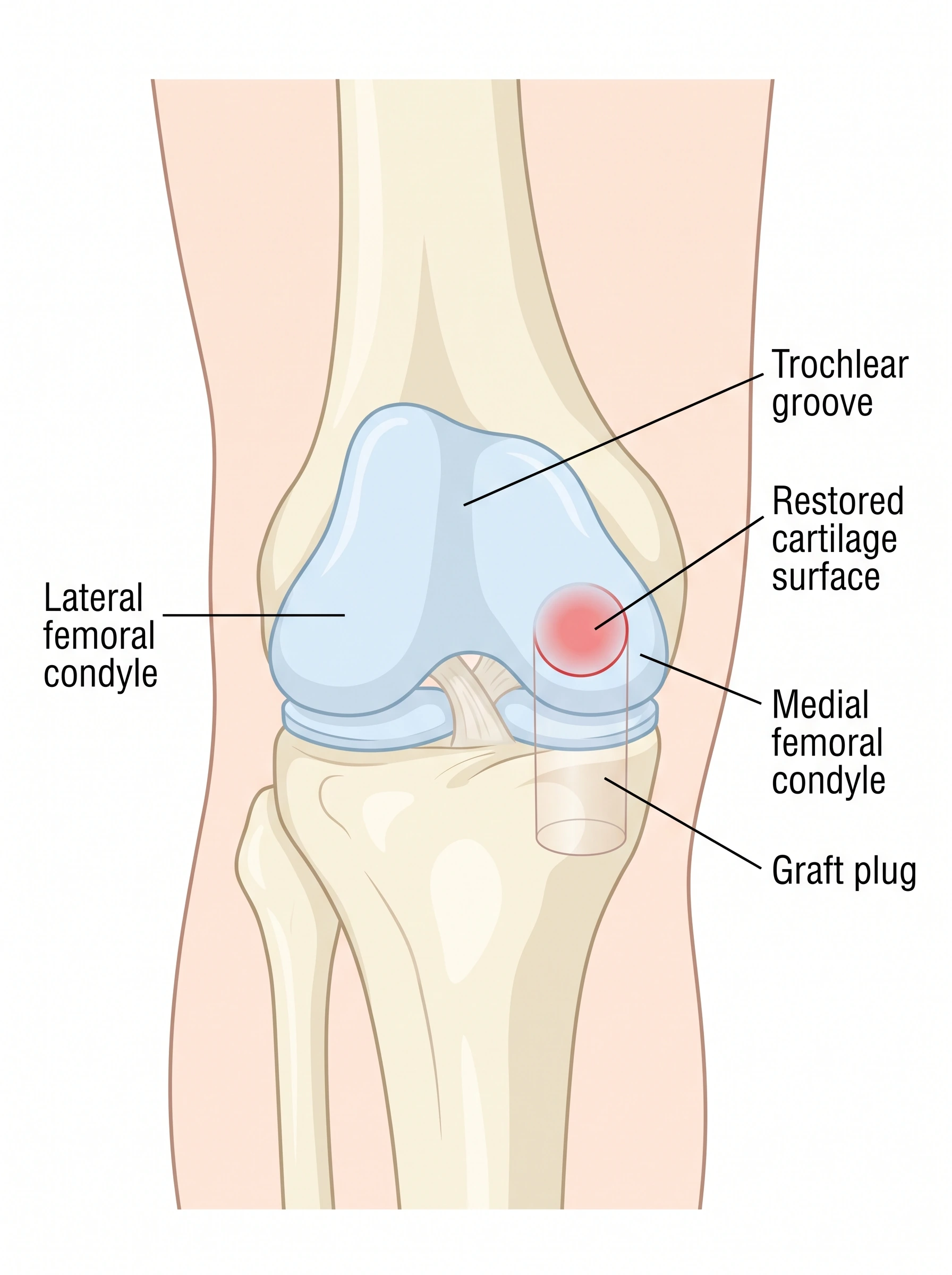
Dr. Wodicka performs cartilage restoration in Fort Lauderdale, procedures that rebuild a damaged patch of the knee's smooth surface. It is considered for select defects in an otherwise healthy knee after non-surgical care. Dr. Wodicka matches the technique to the defect's size and location.
Ross Wodicka performs cartilage restoration in Fort Lauderdale when it is the right step, and reviews every alternative with you first.
What is Cartilage Restoration?
Cartilage restoration is a group of procedures that rebuild a focused area of damaged articular cartilage, the smooth tissue that lets the knee bones glide.
Because cartilage does not heal well on its own, these techniques aim to create a durable surface.
The approach depends on the defect. Some techniques stimulate the body to fill a small defect, while others transfer cartilage and bone or use cells grown from the patient to resurface a larger area.
Restoration is generally for a focused defect in an otherwise healthy knee, not for widespread arthritis. Careful selection is what makes these procedures worthwhile.
What happens during Cartilage Restoration, step by step?
The technique is matched to the defect.
Options include stimulating repair tissue in a small defect, transferring plugs of cartilage and bone, or resurfacing with cells grown from the patient, which may be staged across two procedures. Dr. Wodicka will explain which technique your defect calls for and why.
What is recovery like after Cartilage Restoration?
Restoration usually involves a careful, staged rehabilitation to protect the new surface while it matures.
Weight and motion are often limited early, with a gradual return to activity over several months, and full return to demanding activity can take longer, according to general guidance from the American Academy of Orthopaedic Surgeons. These are ranges, not promises. Your surgical team will set a plan specific to your technique.
Read the full guide to preparing for surgery →
Your own recovery instructions come from the office and are specific to you. This page describes the general course, not a plan to follow.
What do patients ask most?
Who is a good candidate for cartilage restoration?+
What are the main cartilage restoration techniques?+
How long is recovery after cartilage restoration?+
Will cartilage restoration prevent arthritis?+
What are the treatment options?
- 01Activity changes and weight management to reduce load on the defectActivity changes and weight management to reduce load on the defect.
- 02Physical therapy to support the jointPhysical therapy to support the joint.
- 03Anti-inflammatory medicine or an injection when appropriateAnti-inflammatory medicine or an injection when appropriate.
- 04Arthroscopic assessment to size and grade the defectArthroscopic assessment to size and grade the defect.
- 05Cartilage restoration, with the technique chosen to match the defectCartilage restoration, with the technique chosen to match the defect.
Fellowship trained at Southern California Orthopedic Institute, Los Angeles (Sports Medicine). Sees patients in Fort Lauderdale.
About Dr. Wodicka →