Knee osteoarthritis is the slow wearing down of cartilage, the smooth cushion that lets the knee glide. It brings stiffness, aching, and swelling that build over years. Most people improve with activity changes, exercise, weight support, and other non-surgical care. Surgery is one option, not the first step.
Ross Wodicka diagnoses and treats knee osteoarthritis in Fort Lauderdale, from the first visit through recovery.
What is Knee Osteoarthritis?
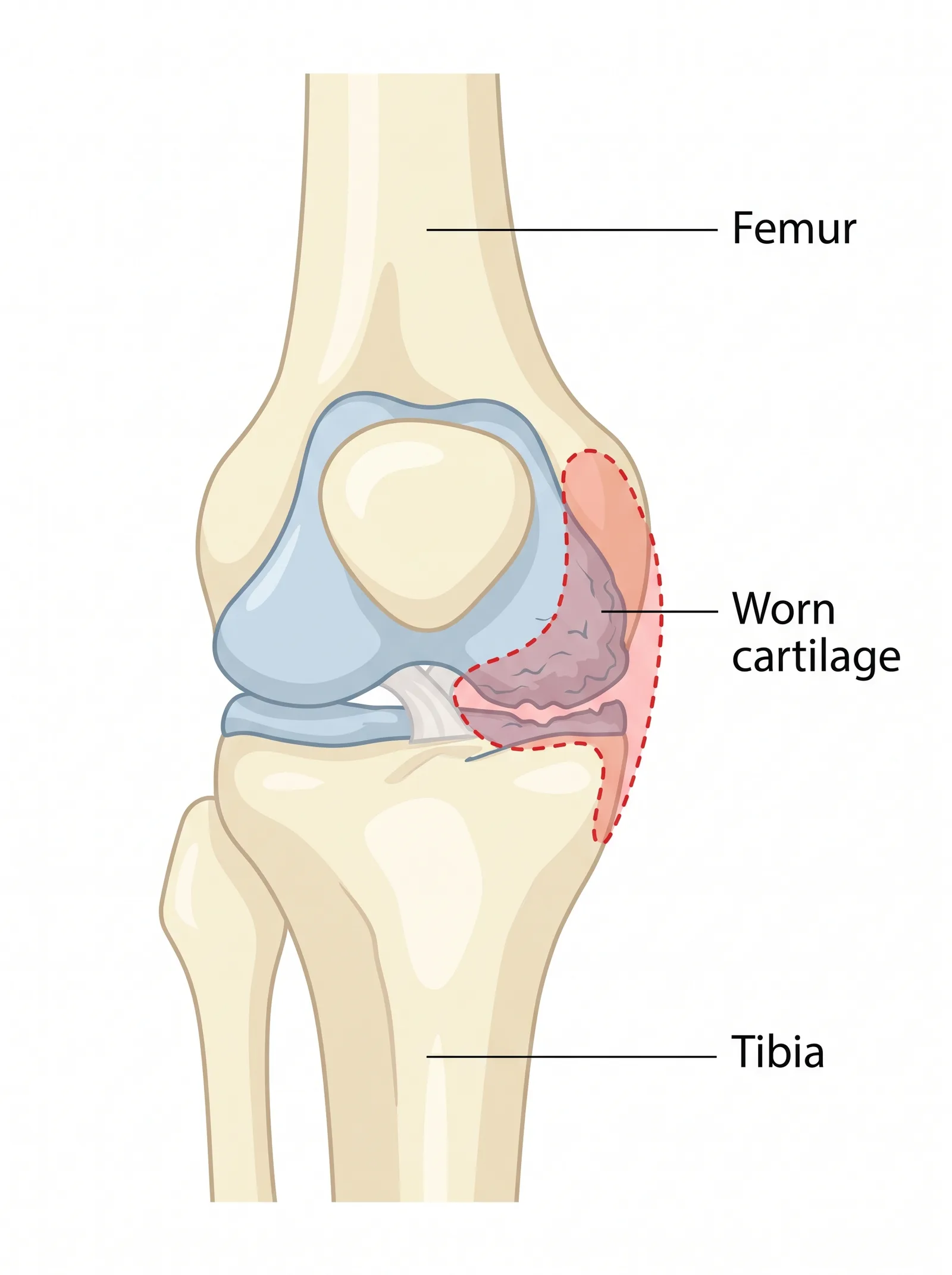
Knee osteoarthritis is a condition in which the cartilage inside the knee gradually thins and roughens.
Cartilage is the smooth, slippery tissue that caps the ends of the bones so they glide against each other without pain. When cartilage wears down, the bones move less smoothly, the joint can become inflamed, and the body sometimes forms small bony ridges called bone spurs, which are extra growths of bone at the edges of the joint.
This is the most common form of arthritis in the knee. It usually develops slowly, over years, rather than all at once. Many people first notice it as a background ache that comes and goes, then settles into a more regular pattern. Osteoarthritis is often called a "wear and tear" condition, but that phrase is only partly right. Genetics, past injuries, joint alignment, body weight, and normal aging all play a part. Two people with the same amount of cartilage change on an X-ray can feel very different day to day.
The knee has three main compartments, which are separate spaces inside the joint: the inner side, the outer side, and the area behind the kneecap. Osteoarthritis can affect one compartment or several. Where the wear sits helps explain where you feel pain and shapes the treatment plan.
It helps to know what osteoarthritis is not. It is not a sign that the knee is falling apart or that you caused it by staying active. In fact, gentle, steady movement usually helps the joint rather than harming it. The goal of care is to calm symptoms, keep the knee moving, and protect your ability to do the things that matter to you.
This deep guide pairs with the shorter overview page on knee osteoarthritis at the office of Ross Wodicka. If you want a quick summary first, start there, then return here when you want the fuller picture.
What are the symptoms of Knee Osteoarthritis, and when should you see a specialist?
In everyday words, knee osteoarthritis tends to feel like this.
- A deep ache in or around the knee, often worse after a long or busy day. - Stiffness in the morning or after sitting for a while, that eases once you move. - Swelling that puffs up after activity and settles with rest. - A grinding, clicking, or catching feeling when you bend or straighten. - The knee feeling like it might "give way" or buckle on stairs or uneven ground. - Trouble with specific tasks: getting out of a low chair, kneeling, or climbing stairs.
Symptoms usually come and go in waves. A flare, which is a stretch of days or weeks when the knee is more painful and swollen, can follow a change in activity, a long trip, or sometimes nothing you can name. Between flares, many people feel close to normal.
It is reasonable to see a knee specialist when:
- Pain has lasted more than about six weeks and is not improving. - The knee swells often, or locks and will not fully straighten or bend. - Pain wakes you at night or keeps you from work, exercise, or sleep. - You are relying on over-the-counter pain medicine most days. - The knee has become unstable, or you have started limiting your walking.
Seek care sooner if the knee is hot, red, and swollen with a fever, if you cannot bear weight after an injury, or if the joint suddenly locks. These can point to problems other than osteoarthritis that need prompt attention.
How is Knee Osteoarthritis diagnosed, and what does the visit involve?
A diagnosis of knee osteoarthritis is usually made from your story and a physical exam, with imaging to confirm and to rule out other causes.
Your visit typically includes:
- A conversation about your history. When the pain started, what makes it better or worse, which activities are hard, past injuries or surgeries, and how symptoms affect daily life. - A physical exam. The specialist looks at how you stand and walk, checks how far the knee bends and straightens, presses along the joint to find tender spots, and tests the ligaments and kneecap. Ligaments are the strong bands that hold the knee together. - X-rays. These show the space between the bones, which narrows as cartilage thins, and reveal bone spurs. X-rays are often taken while you stand, so the joint is under normal load.
Sometimes an MRI is ordered. An MRI is a scan that uses a magnet, not radiation, to show soft tissues such as cartilage and the meniscus, the C-shaped shock absorbers inside the knee. An MRI is not always needed for osteoarthritis, and X-ray findings do not always match how you feel, so the specialist reads the images alongside your symptoms rather than on their own.
If the picture is unclear, blood tests or fluid drawn from the joint may be used to check for other kinds of arthritis or infection. The point of the visit is not only to name the condition but to understand how it affects your life, so the plan fits your goals.
What is the natural course of Knee Osteoarthritis?
Osteoarthritis is a long-term condition, and it helps to know how it usually behaves over time.
This is a general pattern, not a schedule, and individual experiences vary widely.
In the early stage, symptoms tend to be occasional. You might feel stiffness after rest or an ache after a hard day, with long stretches of feeling fine. Many people manage well for years by staying active, keeping the thigh muscles strong, and treating flares as they come.
Over time, some people notice symptoms appearing more often or with less provocation. Stiffness may last a little longer, and certain tasks, such as stairs or kneeling, may become harder. Bone spurs may enlarge, and the joint space seen on X-ray may narrow further. It is important to say clearly that cartilage change on imaging does not always march forward in step with pain. Some knees look worn but feel manageable, and steady self-care can keep things stable for a long time.
For a smaller group, symptoms progress to the point where daily life, sleep, and walking are affected despite full non-surgical care. This is the stage where surgical options are usually discussed. Reaching this point is not a failure of your efforts, and not everyone reaches it.
Flares are part of the natural course. A flare does not mean the joint has suddenly worsened for good. Most flares settle with rest, gentle movement, and the steps that have helped before. Knowing this can take some of the worry out of a hard week.
What is the recovery timeline for Knee Osteoarthritis?
Because osteoarthritis is managed rather than cured, "recovery" here means getting a flare under control and building steady function.
The most useful milestones are based on what you can do, not only on the calendar. Typical time ranges below reflect general guidance from the American Academy of Orthopaedic Surgeons. These are ranges, not promises.
Settling a flare. The goal is less swelling and pain at rest, and being able to walk short distances comfortably. With rest, gentle movement, and anti-inflammatory measures, a flare often calms over roughly one to three weeks. You know you are past it when the knee no longer aches at rest and swelling has gone down.
Building strength and mobility. The goal is fuller, smoother motion and thigh muscles strong enough to steady the knee on stairs. A guided exercise program usually shows meaningful gains over about six to twelve weeks of steady work. The milestone is climbing stairs or rising from a chair with noticeably less effort.
Returning to fuller activity. The goal is doing your regular walking, hobbies, or low-impact exercise without a setback. Many people reach a comfortable routine over a few months of consistent management. The milestone is a normal week with only occasional, manageable symptoms.
The pattern matters more than any single day. Progress in osteoarthritis is rarely a straight line; expect good weeks and harder weeks, with the overall trend improving as strength builds and habits settle.
How should you prepare for your visit?
You can get more from your specialist visit with a little preparation.
Consider bringing.
- A symptom timeline. When the pain began, how it has changed, and what a typical week looks like now. - A list of what makes it better and worse. Specific activities, times of day, and any steps that already help. - Your goals. The tasks you most want to get back to, whether that is a set of stairs at home, a favorite walk, or a sport. - A medication list. Everything you take, including over-the-counter pain medicine and supplements, with how often you use them. - Past records. Any prior X-rays, MRI scans, or notes from earlier knee care, if you have them. - Questions. Write them down so nothing gets forgotten in the moment.
It also helps to wear or bring loose clothing so the knee can be examined and to plan for a short walk in the office as part of the exam. If insurance coverage is on your mind, the office staff can answer those questions directly.
Which warning signs should you call about?
Most osteoarthritis symptoms are managed at your own pace, but some signs deserve a prompt call.
Contact the office if you notice the following.
- The knee becoming hot, red, and swollen, especially with a fever or feeling unwell. This can signal infection. - A sudden, large increase in swelling or pain without a clear cause. - The knee locking so you cannot fully straighten or bend it. - New instability, where the knee buckles or gives way often. - Calf pain, swelling, warmth, or tenderness, which should be checked promptly. - Pain that is no longer controlled by the steps that usually help.
For an injury, sudden inability to bear weight, or a knee that gives way and causes a fall, call the office for guidance. For severe symptoms such as a hot, swollen joint with fever, chest pain, or trouble breathing, seek emergency care right away. When in doubt, call the office of Ross Wodicka at (954) 542-4160; the team can help you decide what to do next.
What results can you expect from Knee Osteoarthritis?
It is fair to ask what results people can expect.
The honest answer is that osteoarthritis is highly manageable for most people, though results vary and the numbers below are ranges, not guarantees.
According to general guidance from the American Academy of Orthopaedic Surgeons, most people with knee osteoarthritis improve their symptoms and function with non-surgical care such as exercise, weight support, and medication, and many manage the condition this way for years without surgery.
The American College of Rheumatology, in guidance published in 2019, strongly recommends exercise and, for those who are overweight, weight loss as core treatments, based on consistent evidence that they reduce pain and improve function.
For people who do eventually have knee replacement surgery, general guidance from the American Academy of Orthopaedic Surgeons notes that most report meaningful, lasting relief of pain and improved function, though recovery takes time and outcomes differ from person to person.
What these figures share is a message of realistic hope: the large majority of people find a level of comfort and activity they can live with, most without an operation. Your own path depends on many factors, which the specialist will discuss in the context of your knee.
What do patients ask most?
Will staying active make my knee worse?+
Does a worn-looking X-ray mean I need surgery?+
Do injections cure osteoarthritis?+
Is knee osteoarthritis something I caused?+
How do I know when it is time to consider surgery?+
What are the treatment options?
- 01Movement and exerciseA guided program that strengthens the muscles around the knee, especially the thigh muscles, takes load off the joint and reduces pain. Low-impact activity such as walking, cycling, or water exercise keeps the joint nourished and mobile. A physical therapist, a clinician who teaches targeted exercises, can tailor a program to you.
- 02Weight supportExtra body weight adds force across the knee with every step. Even modest weight loss can meaningfully lower the load and ease symptoms, according to general guidance from the American Academy of Orthopaedic Surgeons. This is often gradual work, and support from your care team helps.
- 03MedicinesOver-the-counter anti-inflammatory medicine can calm pain and swelling. Topical creams and gels applied to the skin over the knee help some people with fewer whole-body effects. Any medicine, even one bought without a prescription, is worth reviewing with your clinician if you use it often or take other medications.
- 04Braces and supportsA brace can steady the knee or shift load away from the worn compartment. A cane or trekking pole, used on the opposite side, reduces the force through the painful knee.
- 05InjectionsA corticosteroid injection, a shot of anti-inflammatory medicine into the joint, can quiet a flare for a stretch of weeks to months. Other injections exist, and the evidence for them varies, so the specialist will explain what is reasonable for your situation.
- 06Activity adjustmentsSmall changes, such as swapping deep squats for gentler motion or breaking a long walk into shorter pieces, protect the joint while keeping you active.
Fellowship trained at Southern California Orthopedic Institute, Los Angeles (Sports Medicine). Sees patients in Fort Lauderdale.
About Dr. Wodicka →