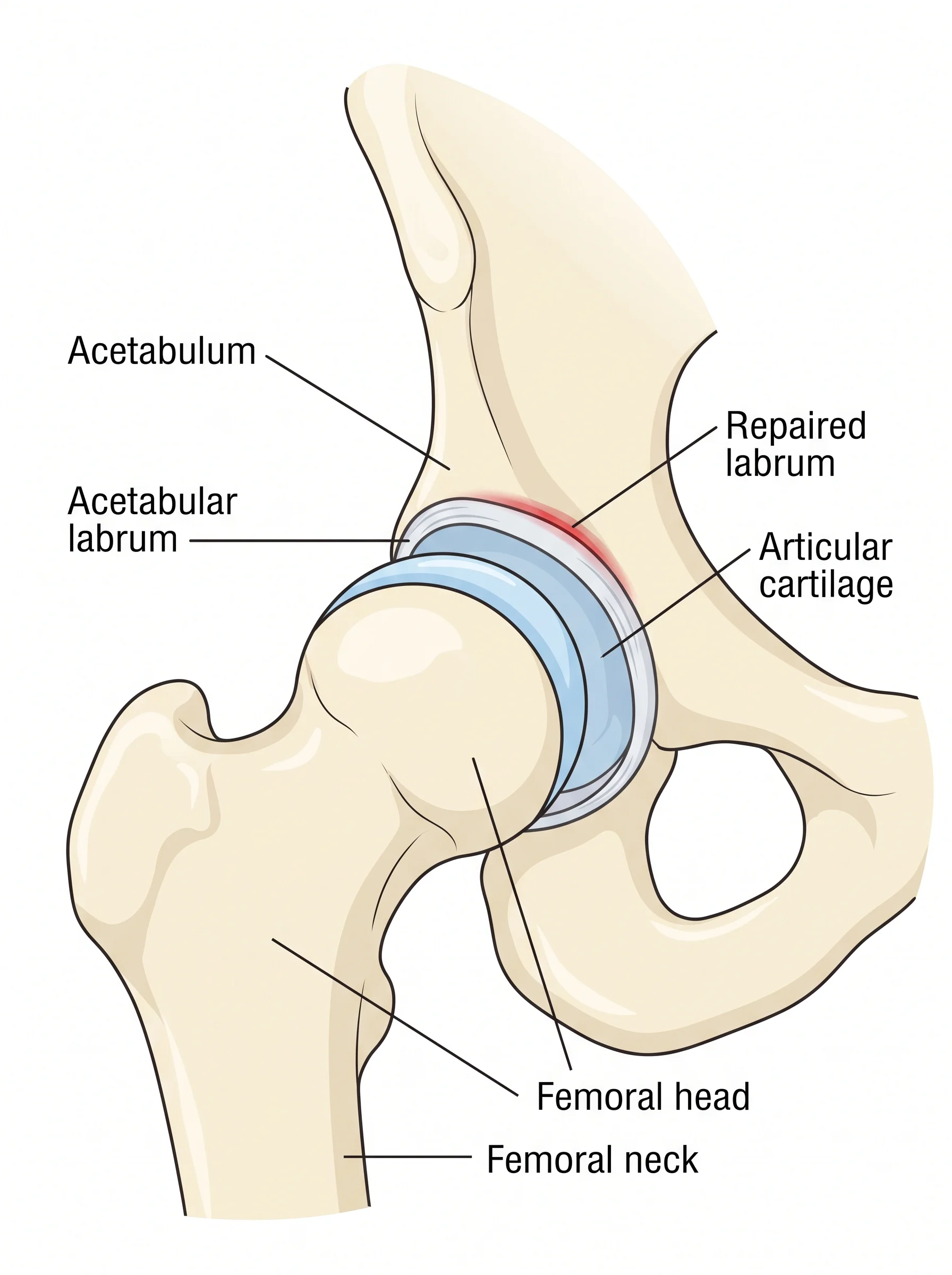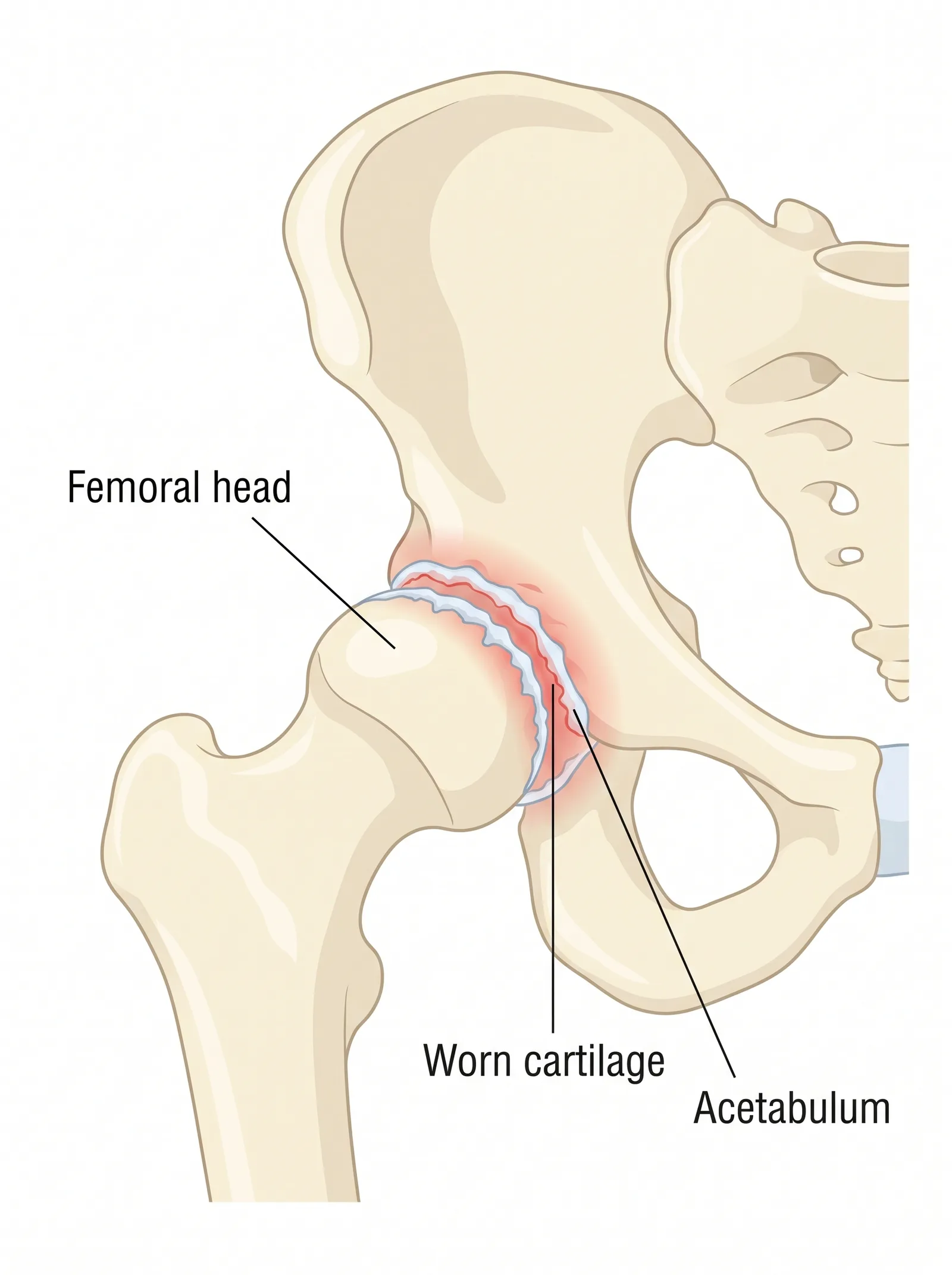
Hip osteoarthritis is the slow wearing of cartilage, the smooth cushion that lets the ball and socket of the hip glide. It builds over years and shows up as groin pain, stiffness after rest, and trouble with stairs or putting on socks. Treatment starts with non-surgical care. Hip replacement is one option later, when those stop helping.
Ross Wodicka diagnoses and treats hip osteoarthritis in Fort Lauderdale, from the first visit through recovery.
What is hip osteoarthritis?
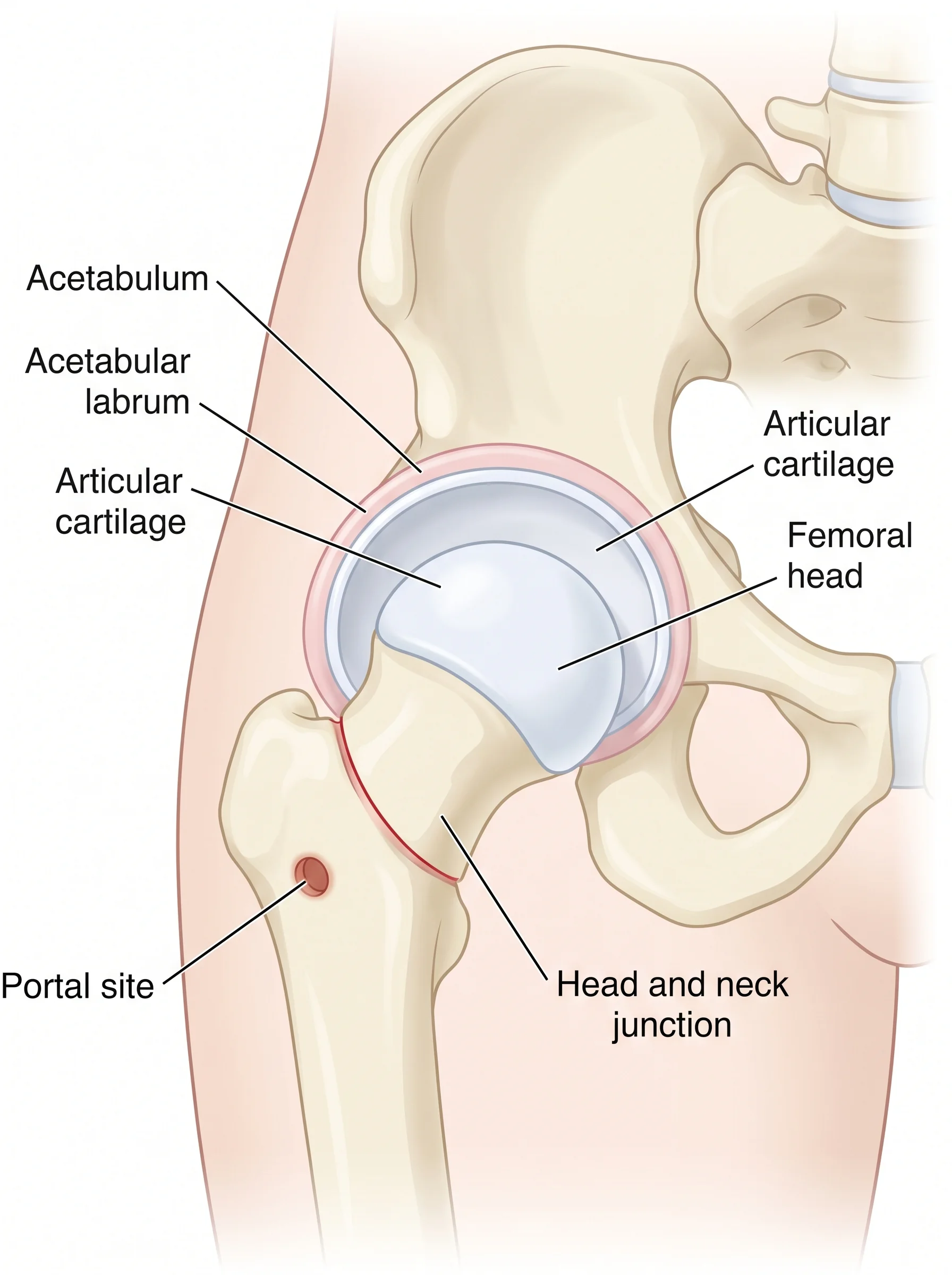
The hip is a ball-and-socket joint.
The upper end of the thigh bone forms a ball, and the pelvis forms a cup, called the socket. Both surfaces are lined with cartilage, a firm and slippery tissue that lets the bones move without grinding. Hip osteoarthritis is the gradual thinning and roughening of that cartilage. Osteoarthritis is often shortened to OA.
As the cartilage wears, the space between the ball and socket narrows. The bone underneath thickens, and small bony bumps called bone spurs can form at the edges. The joint lining can swell and make extra fluid. None of this happens overnight. Hip OA usually develops across years, which is why many people notice it first as a stiffness they worked around for a long time.
Age is the most common reason cartilage wears, but it is not the only one. A past hip injury, years of heavy impact on the joint, the shape of the hip a person was born with, and a family history of arthritis all raise the chance. Some people have hip shapes that put uneven pressure on the cartilage, such as femoroacetabular impingement or hip dysplasia, and these can lead to OA earlier in life. Those two conditions have their own pages in this library.
Hip OA is common, and it is manageable. Many people live active lives for years with a worn hip by adjusting activity and using non-surgical care. The goal of treatment is to keep you moving with less pain, and to make the larger decisions calmly and on your own timeline.
What are the symptoms of Hip Osteoarthritis, and when should you see a specialist?
People with hip OA usually describe pain in the groin or the front of the hip, not on the outer side.
The pain can spread down toward the knee, which sometimes leads people to think the problem is the knee. Common ways patients describe it.
- A deep ache in the groin that is worse with walking or standing for a while. - Stiffness in the morning, or after sitting for a stretch, that eases once you move around. - Trouble with things that turn or bend the hip, like putting on socks and shoes, getting out of a low car seat, or clipping toenails. - A catch, grind, or clicking feeling deep in the joint. - A limp, or the sense that one leg tires faster. - Pain that used to come only with activity now showing up at rest or at night.
Early on, the pain often comes and goes and lines up with how much you did that day. Over time the good stretches get shorter. There is no single day when you must see a specialist, but these are good reasons to make an appointment: hip or groin pain that has lasted more than a few weeks, pain that wakes you at night, a limp that is not going away, or stiffness that is starting to shrink what you can do. Seeing a specialist early does not mean surgery is next. It means you get an accurate picture and a plan that starts with the gentlest steps.
Some symptoms deserve prompt attention rather than watchful waiting. Sudden and severe hip pain after a fall, an inability to put weight on the leg, or a hip that looks turned or shortened can point to a fracture and should be evaluated the same day.
How is Hip Osteoarthritis diagnosed, and what does the visit involve?
A diagnosis of hip OA is made from your story and an exam, with imaging to confirm.
There is no blood test that diagnoses osteoarthritis.
The visit usually starts with questions: where the pain sits, what makes it better or worse, how long you have had it, and what it keeps you from doing. This history often points to the hip before anything else is done.
Next is a physical exam. The specialist will watch you walk, then move your hip through its range of motion. With OA, certain positions, especially turning the hip inward while the knee is bent, tend to reproduce the groin pain and show reduced motion. The exam also helps rule out other sources, such as the lower back, which can send pain into the hip area.
X-rays are the main imaging test. They show the joint space narrowing, bone spurs, and changes in the bone that fit the pattern of OA. X-rays are quick and use a small amount of radiation. In some cases a specialist orders an MRI, a scan that shows soft tissues in detail, if the X-ray does not explain the symptoms or if a labral tear or other soft-tissue problem is suspected. Most people with straightforward hip OA do not need an MRI.
One honest note about imaging: X-ray changes and pain do not always match. Some people have marked changes and little pain, and others have severe pain with milder changes. This is why the plan is built around how you feel and function, not the film alone.
What is the natural course of Hip Osteoarthritis?
Hip OA is a condition that tends to progress slowly, but the path is not the same for everyone, and it is not a straight downhill line.
Understanding the usual course can help you plan without alarm.
In the early phase, pain is intermittent. It shows up after a long walk or a busy day and settles with rest. Many people manage this phase for years with activity changes and occasional medication. Cartilage does not grow back, so the wear itself does not reverse, but symptoms can hold steady or even improve with the right care.
In a middle phase, the good stretches shorten. Pain may start earlier in the day and linger longer. Stiffness after sitting becomes more noticeable. This is often when people add physical therapy, a cane, or injections, and when many first see a specialist.
In a later phase, pain can become more constant, including at rest or at night, and the hip's motion narrows enough to limit daily tasks like dressing or getting in and out of a car. Not everyone reaches this phase, and reaching it is not an emergency. It is the point at which many people decide that the trade-offs of hip replacement are worth it for the return of comfort and motion.
There is no clock forcing a decision. Two people with similar X-rays can make very different, equally reasonable choices. The right time to act is when the hip is costing you the activities that matter, and non-surgical care is no longer enough.
What is the recovery timeline for non-surgical care and beyond?
Because hip OA is managed rather than cured, "recovery" here means getting back function and comfort, and the milestones are things you can do rather than dates on a calendar.
If you and your specialist do move toward hip replacement, that procedure has its own detailed recovery page in this library.
For non-surgical care, progress is measured by capability:
- Early milestone: you can complete a short daily walk without a pain flare afterward. For many people starting physical therapy, comfort with light activity builds over the first several weeks, according to general guidance from the American Academy of Orthopaedic Surgeons. These are ranges, not promises. - Building milestone: you can climb a flight of stairs, get in and out of a car, and put on socks with less difficulty than before. This often reflects gains in strength and flexibility that build over weeks to a few months of consistent exercise. - Steady-state milestone: you have a routine, whether that is a cane on long days, a set of home exercises, and activity swaps, that keeps pain at a level you can live with and lets you do what matters to you.
The honest framing is that non-surgical care manages symptoms and can hold them steady for years, but it does not restore worn cartilage. If symptoms outgrow it, that is information, not failure. It simply means the next conversation is worth having.
How should you prepare for your visit?
You do not need surgery to benefit from being prepared.
A good first visit for hip pain goes faster and further when you bring a few things.
- Your history of the pain. When it started, where it sits, what makes it better and worse, and what it keeps you from doing. Writing this down beforehand helps. - A list of what you have already tried. Medications, activity changes, therapy, injections, and how each worked. - Your other health conditions and medications, including over-the-counter drugs and supplements, since these affect which treatments are safe for you. - Your goals in plain terms. "I want to walk the dog without stopping" or "I want to travel without pain" tells a specialist more than "I want to feel better." - Comfortable clothing that lets the hip be examined and lets you walk for the gait check. - Any prior imaging or the name of the place that has it, so films do not have to be repeated.
If you have insurance questions, such as what an office visit or imaging will cost you, the office can answer those directly. Bring your insurance information to the visit.
Which warning signs should you call about?
Most hip OA is a slow condition, not an emergency.
But some signs deserve a prompt call rather than waiting for your next appointment. Call the office if you notice the following.
- Sudden, severe hip or groin pain, especially after a fall. - A sudden inability to put weight on the leg, or a leg that looks turned outward or shorter than the other. - New numbness, tingling, or weakness in the leg. - Redness, warmth, and swelling over the hip along with a fever, which can point to infection. - Pain that has quickly become much worse over days rather than the slow change you are used to.
If any symptom feels severe or frightening, or you cannot reach the office, seek emergency care. For non-urgent questions about your hip, the office is the right first call, and the contact information is on the practice's contact page.
What results can you expect from Hip Osteoarthritis?
Because hip OA is managed with a ladder of treatments, outcomes depend on which steps you use and where you are in the condition's course.
A few points can be stated with sourcing.
- Osteoarthritis is one of the most common causes of hip pain and disability in older adults, according to general information from the American Academy of Orthopaedic Surgeons. - Non-surgical measures, including exercise, weight management, and activity changes, can meaningfully reduce pain and improve function for many people, according to general guidance from the American Academy of Orthopaedic Surgeons. The size of the benefit varies from person to person. These are ranges of experience, not promises. - When non-surgical care no longer controls symptoms, hip replacement is a well-established option that reliably relieves pain and improves function for most people who have it, according to general information from the American Academy of Orthopaedic Surgeons. Detailed, sourced outcome ranges for that procedure live on its own page in this library.
No number here is a guarantee for one person. Your health, your activity, and the demands of your daily life all shape your result, and your specialist can put these figures in the context of your own hip.
What do patients ask most?
Is hip osteoarthritis the same as "wear and tear"?+
Does exercise make hip arthritis worse?+
Will I definitely need a hip replacement?+
Why does my knee hurt if the problem is my hip?+
Can losing weight really change my hip pain?+
What are the treatment options?
- 01Activity changesSwapping high-impact activity for lower-impact movement often lowers pain while keeping you active. Walking, cycling, and swimming are common choices. The goal is to stay moving, since a hip that stops moving tends to stiffen.
- 02Weight managementThe hip carries several times your body weight with each step. For people who carry extra weight, losing some can reduce the load on the joint. This is one of the steps with the most evidence behind it, according to general guidance from the American Academy of Orthopaedic Surgeons.
- 03Physical therapyA physical therapist, a movement specialist, can teach exercises that strengthen the muscles around the hip and improve range of motion. Stronger hip and core muscles share the load and can ease pain.
- 04MedicationOver-the-counter pain relievers such as acetaminophen or nonsteroidal anti-inflammatory drugs, often shortened to NSAIDs, can lower pain and swelling. NSAIDs are not right for everyone, so the office can help you weigh them against your other health conditions.
- 05Assistive devicesA cane held in the hand opposite the sore hip can take a surprising amount of load off the joint. A shoe insert or a raised toilet seat can make daily tasks easier.
- 06InjectionsA corticosteroid injection, a shot of anti-inflammatory medicine into the joint, can calm a painful flare for a period of time. It does not repair cartilage, and its relief is temporary, but it can help you get through a rough stretch or stay active while other steps take hold.
Fellowship trained at Southern California Orthopedic Institute, Los Angeles (Sports Medicine). Sees patients in Fort Lauderdale.
About Dr. Wodicka →